-
|
-
Antibodies from SYSY Antibodies are designed to deliver consistent and reliable staining, especially when used in accordance with our validated reference protocols.
Monoclonal antibodies are produced from a single clone of B cells (often fused with myeloma cells to create hybridomas) and consist of identical immunoglobulins, usually IgG or sometimes IgM. They recognize one specific epitope, providing high specificity with minimal cross-reactivity.
Recombinant antibodies are monoclonal antibodies that are produced in vitro by using known antibody coding genes. As they are produced under highly defined and controlled conditions they ensure exceptional batch-to-batch consistency (see also our featured topic on recombinant antibodies).
Polyclonal antibodies are a mixture of antibodies produced by different B cell clones, each recognizing multiple epitopes on the target antigen. As a result, they are often more sensitive and tolerant to minor changes in antigen structure, but less specific than monoclonal antibodies, which can sometimes lead to increased background staining.
Although SYSY Antibodies provides recommended starting dilutions for all antibodies, empirical optimization is strongly advised, as the ideal dilution can vary depending on tissue type and experimental conditions. For polyclonal antibodies derived from new immunizations, re-titration may be necessary to maintain optimal performance (see our FAQ on SYSY Antibodies lot numbers for details.)
In immunohistochemistry (IHC), the optimal incubation condition depends on the antibody and the balance between sensitivity and convenience. Incubating primary antibodies overnight at 4 °C often enhances specificity and reduces background, making it particularly useful for weak, low-affinity, or nonspecific-prone antibodies. This approach also improves penetration in thicker or free-floating sections and is therefore recommended in the IHC protocols from SYSY Antibodies. Shorter incubation times at room temperature result in faster workflows and are usually sufficient for strong antibodies with high affinity. To ensure compatibility with automated IHC platforms, SYSY Antibodies' IHC-P reference protocols generally recommend incubating the primary antibody at room temperature for 60 minutes.
Key Considerations
Optimizing incubation conditions ensures reliable and reproducible immunohistochemical staining results.
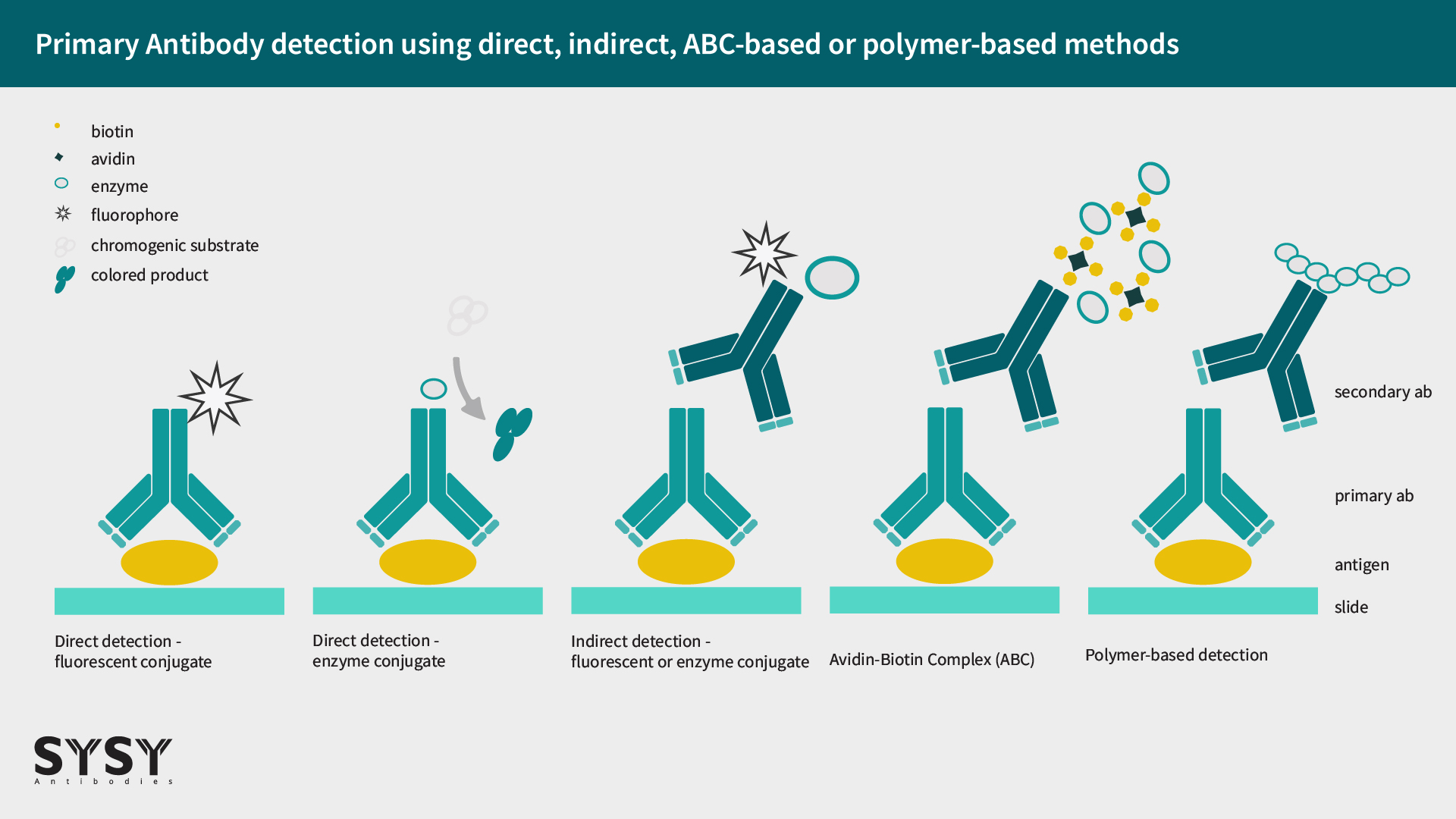
The success of an IHC assay is highly influenced by the detection system used to visualize the target antigen. Key factors such as sensitivity, specificity, and staining quality are directly affected by the detection method—whether direct or indirect—as well as the choice of labeling agents, including enzymes or fluorochromes (Figure 1). Selecting the appropriate system is essential for achieving clear, accurate, and reproducible results.
The primary antibody is labeled with enzymes or fluorochromes, enabling immediate visualization without a secondary antibody. This method is fast and straightforward but may produce weak signals, especially when antigen expression is low.
A secondary antibody directed against the host species of the primary antibody amplifies the signal and is conjugated to a reporter, such as an enzyme (HRP or AP) or a fluorophore. An exception are biotin-labeled primary antibodies, which are detected with streptavidin conjugated to a reporter enzyme or fluorophore. Indirect detection methods are generally preferred due to their higher sensitivity compared to direct labeling.
The Avidin-Biotin Complex (ABC) method amplifies the signal strength through a biotin-streptavidin or biotin-avidin enzyme complex. Tissue-bound primary antibodies are linked to avidin-biotin enzyme complexes via biotin-conjugated secondary antibodies. However, some tissues (e.g. kidney, liver) contain high amounts of endogenous biotin, which can lead to background noise or false-positive results, especially when using Tris-EDTA or EDTA-based antigen retrieval buffers. Blocking endogenous biotin can reduce the background.
Polymer-based detection systems increase sensitivity by combining multiple enzymes and secondary antibodies via a polymer backbone. Compared to ABC methods, higher signal intensities are achieved without biotin-related background problems. This is especially recommended for tissues with high background or when higher sensitivity is required.
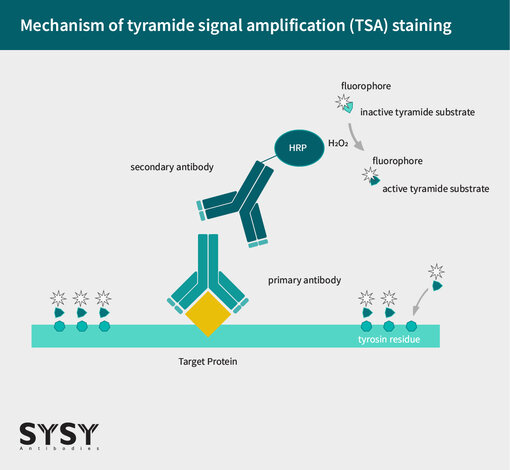
TSA is an enzyme-mediated amplification method that significantly increases sensitivity. Using horseradish peroxidase (HRP), a tyramide reagent is catalyzed into an active form in the presence of H2O2 so that it can bind all tyrosine residues in its environment. These labels are then detected either directly by fluorescence or indirectly by biotin and a chromogenic detection method (Figure 2&3). TSA can increase the detection rate by up to 100-fold compared to ABC methods and is therefore ideal for low abundance proteins.
Figure 2: Mechanism of tyramide signal amplification (TSA) staining.
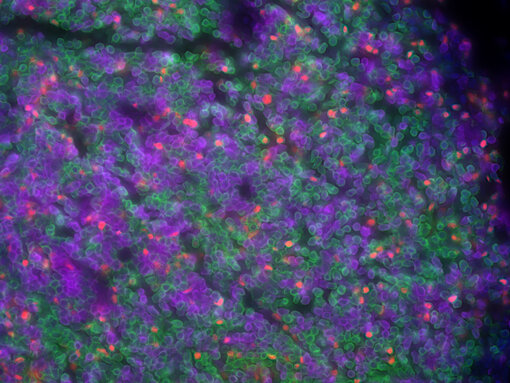
Figure 3: Indirect immunostaining of a formalin fixed paraffin embedded (FFPE) mouse thymus section using TSA with rat anti-FoxP3 (cat no. HS-491 017, dilution 1:1000, red), rabbit anti-CD8a (cat. no. HS-361 008, dilution 1:250, purple) and guinea pig anti-CD4 (cat. no. HS-360 308, 1:200, green). Nuclei have been visualized by DAPI staining (blue).
Secondary antibodies can cross-react with endogenous immunoglobulins in tissue, leading to non-specific staining. To minimize this:
SYSY Antibodies recommends performing a control without a primary antibody to control for non-specific staining. This ensures that any observed staining is due to the specific binding of the primary antibody and not to artifacts of the detection system or autofluorescence of the tissue (see also IHC Controls).
Certificates
ISO 9001 2015 Quality Management System and Green Lab Platinum certification level for sustaining laboratory processes.


Newsletter
Sign up for our newsletter and get the latest updates and news.