-
|
-
Multiplex immunohistochemistry (IHC) allows the detection of multiple targets on a single slide, making it particularly valuable when single IHC is insufficient to visualize the anticipated result, such as immunophenotyping using multiple markers. Multiplex IHC can be performed using fluorophores or chromogenic substrates. However, fluorescent IHC has advantages over brightfield IHC. It uses multiple spectral peaks of light emission against a dark background, enabling better multiplexing.
In indirect IHC, primary antibodies should ideally come from different host species to prevent cross-reactivity of secondary systems. However:
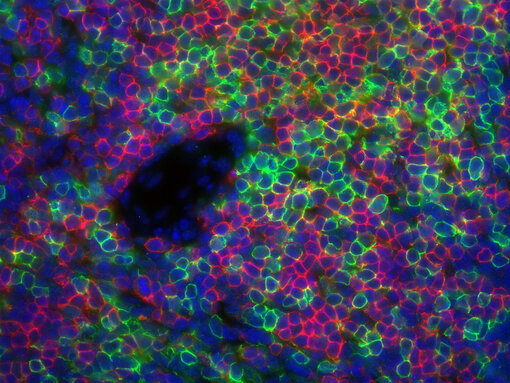
Figure 1: Non-colocalized markers in mouse spleen. Indirect immunostaining of a formalin fixed paraffin embedded (FFPE) mouse spleen section using rabbit anti-mouse CD8a (cat. no. HS-361 008, dilution 1:100, green) and rat anti-mouse CD4 (cat. no. HS-360 117, dilution 1:100, red). Nuclei have been visualized by DAPI staining (blue).
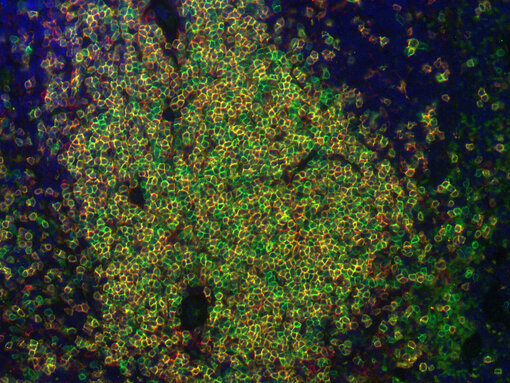
Figure 2: Colocalized markers in mouse spleen. Indirect immunostaining of a formalin fixed paraffin embedded (FFPE) mouse spleen section using rabbit anti-mouse CD3e (cat. no. HS-413 108, dilution 1:100, green) and rat anti-mouse CD4 (cat.no. HS-360 117, dilution 1:100, red). CD3e+ CD4+ double-positive cells (T helper cells) appear yellow. Nuclei have been visualized by DAPI staining (blue).
Secondary antibodies may cross-react with endogenous immunoglobulins or produce false-positive staining due to non-specific binding. In Multiplex IHC-P, they can also cross-react with each other. To prevent this:
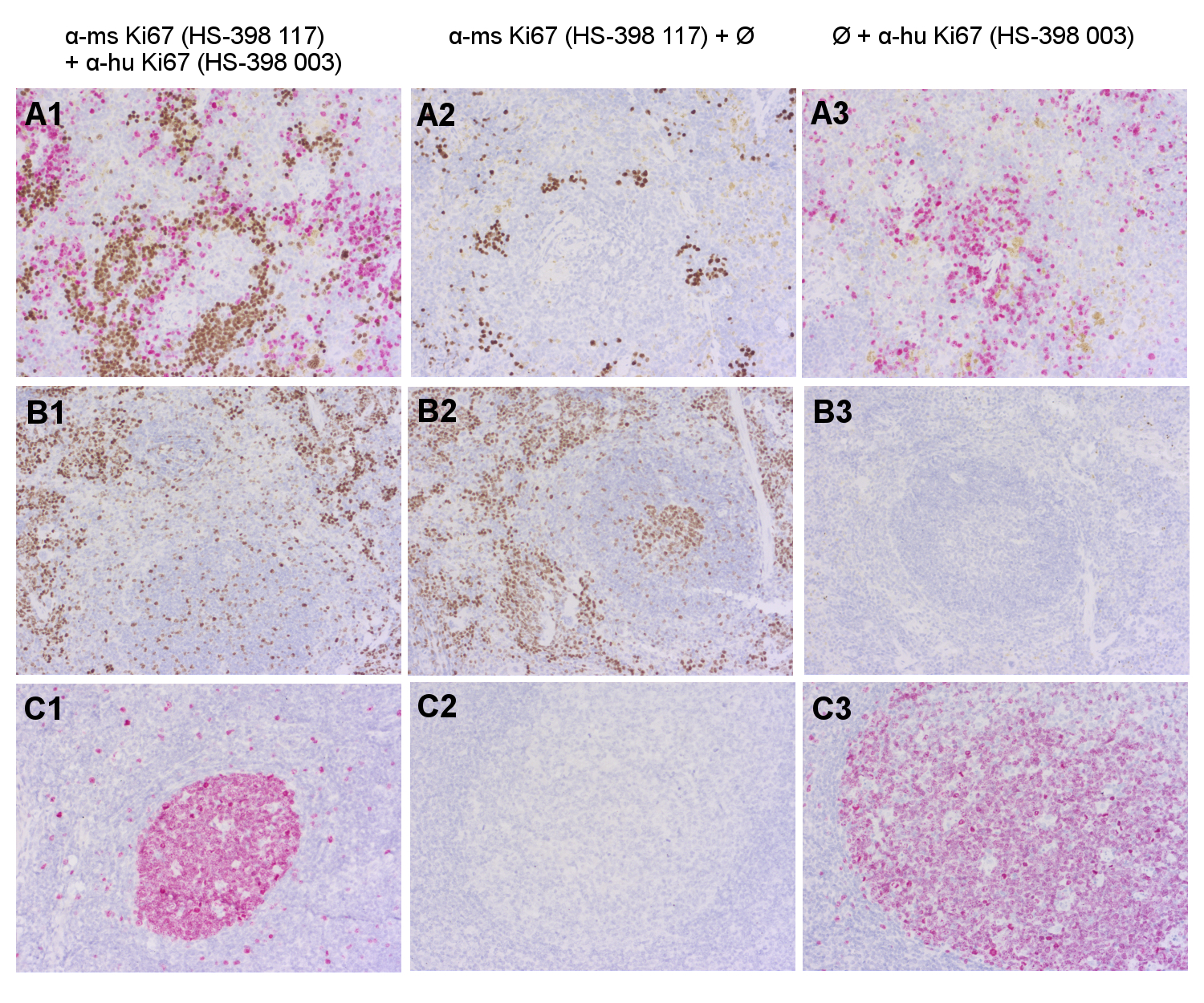
Figure 3: Establishing a multiplex protocol for anti-mouse and anti-human Ki67 in mouse spleen engrafted with human CD34⁺ cells. Immunohistochemical doublestaining of formalin fixed paraffin embedded (FFPE) mouse (A1-3: mouse spleen engrafted with human CD34+-cells; B1-3: wildtype mouse spleen) and human (C1-3: human tonsil) tissues using rabbit anti-human Ki67 (cat. no. HS-398 003, AP-RED, red) and rat anti-mouse Ki67 (cat. no. HS-398 117, DAB, brown). Specificity of the staining was verified by omitting either the anti-human Ki67 primary antibody (column 2) or the anti-mouse Ki67 primary antibody (column 3) in the doublestaining protocol. Nuclei have been visualized by hematoxylin staining (blue).
Figure 3 shows how a multiplex protocol for anti-mouse and anti-human Ki67 is created in a mouse spleen transplanted with human CD34⁺ cells (A1–A3). A mouse spleen (B1–B3) and a human tonsil (C1–C3) are used as positive controls for anti-mouse Ki67 and anti-human Ki67 staining, respectively. The staining protocols for single antibody staining were optimized in advance. The omission controls (column 2: anti-human Ki67 omitted; column 3: anti-mouse Ki67 omitted) show comparable staining results to the respective antibody used in the double staining protocol (column 1).
Different primary antibodies may require distinct antigen retrieval conditions for optimal staining. Preliminary single-stain IHC-P tests should be conducted to determine a retrieval protocol compatible with all primary antibodies used in multiplex staining (see Antigen Retrieval).
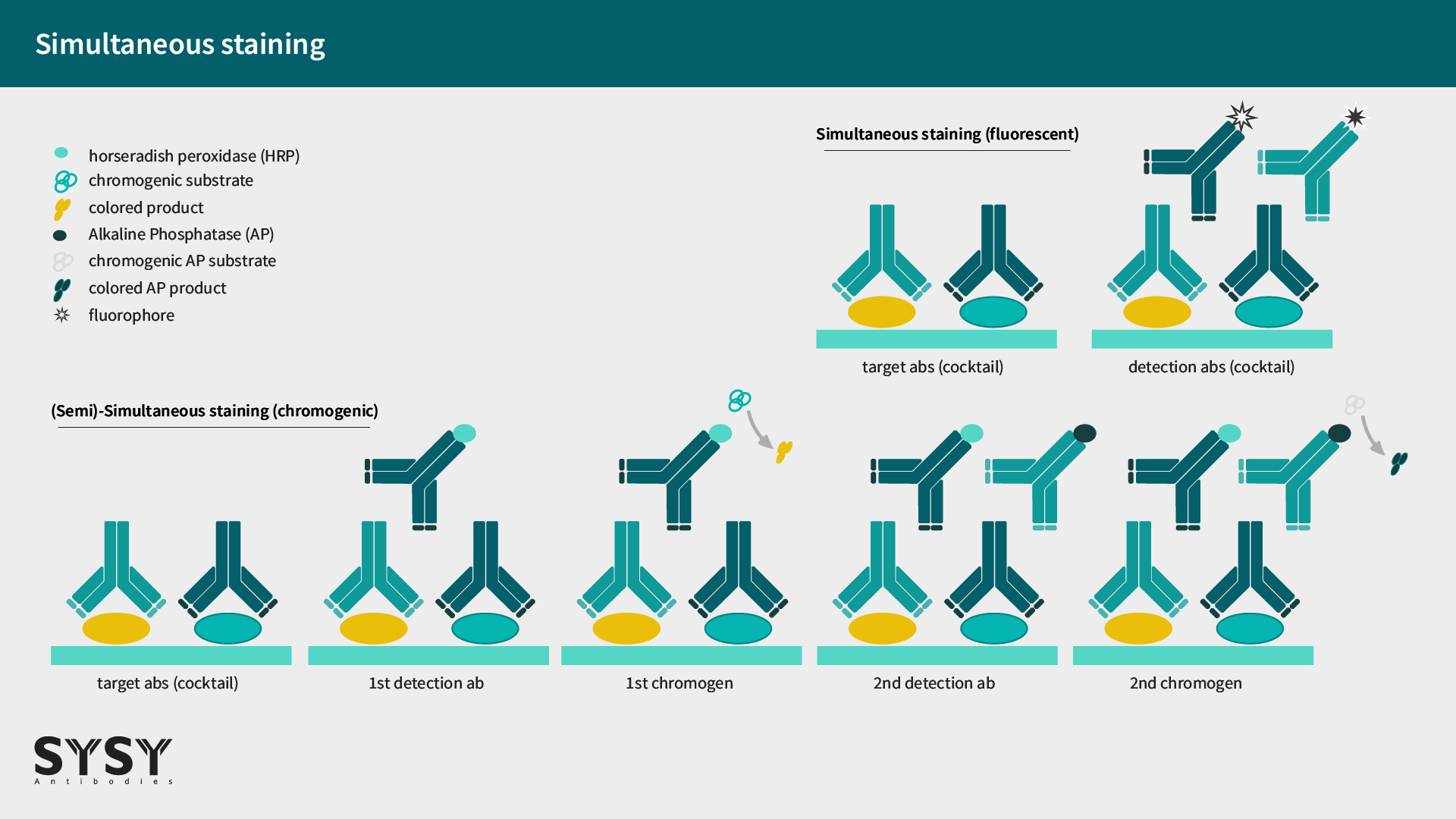
Multiplex IHC can be performed using simultaneous or sequential protocols. In simultaneous staining (Figure 4) primary antibodies are applied together as a mixture. This method is typically used when multiple primary antibodies come from different host species, so their respective secondary antibodies won’t cross-react. It is not appropriate when antibodies come from the same host species (risk of cross-reactivity) or when signal amplification methods like TSA are being used. Simultaneous staining is faster than sequential staining but may reduce antibody performance in chromogenic IHC due to increased washing steps.
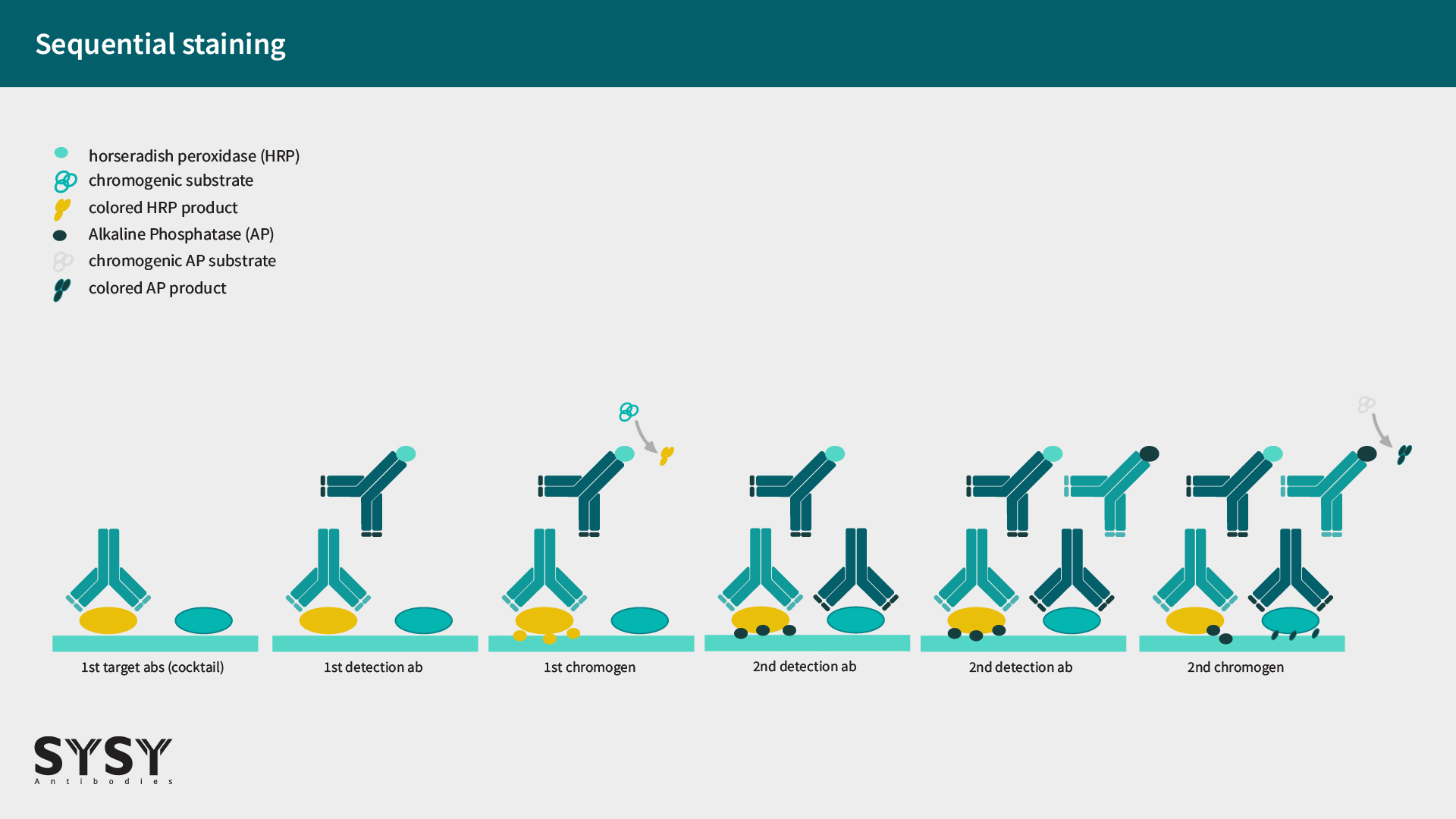
In sequential staining, the antibodies are not applied all at once, but in several rounds of staining one after the other (Figure 5). This can be useful when two primary antibodies come from the same host species. By removing or "stripping" the first primary antibody and its associated secondary detection system, researchers can then apply a second primary antibody from the same species, followed by a different detection system, thus avoiding cross-reactivity. Sequential staining also reduces the risk of nonspecific secondary binding. Due to the underlying chemistry, sequential staining plays a central role in tyramide signal amplification (TSA)-based multiplexed immunofluorescence (IF). After each round, HRP is inactivated or stripped, allowing new antibodies to be applied and detected. In chromogenic sequential staining, when DAB is used first, its dense brown precipitate can create a “shielding” or “sheltering” effect. This may obscure or physically block access to subsequent antibodies and chromogens, potentially reducing sensitivity and complicating interpretation of later targets.
Regardless of the staining method chosen, always compare the results of multiplex staining with those of single stainings to evaluate the performance of the individual antibodies.
Certificates
ISO 9001 2015 Quality Management System and Green Lab Platinum certification level for sustaining laboratory processes.


Newsletter
Sign up for our newsletter and get the latest updates and news.