-
|
-
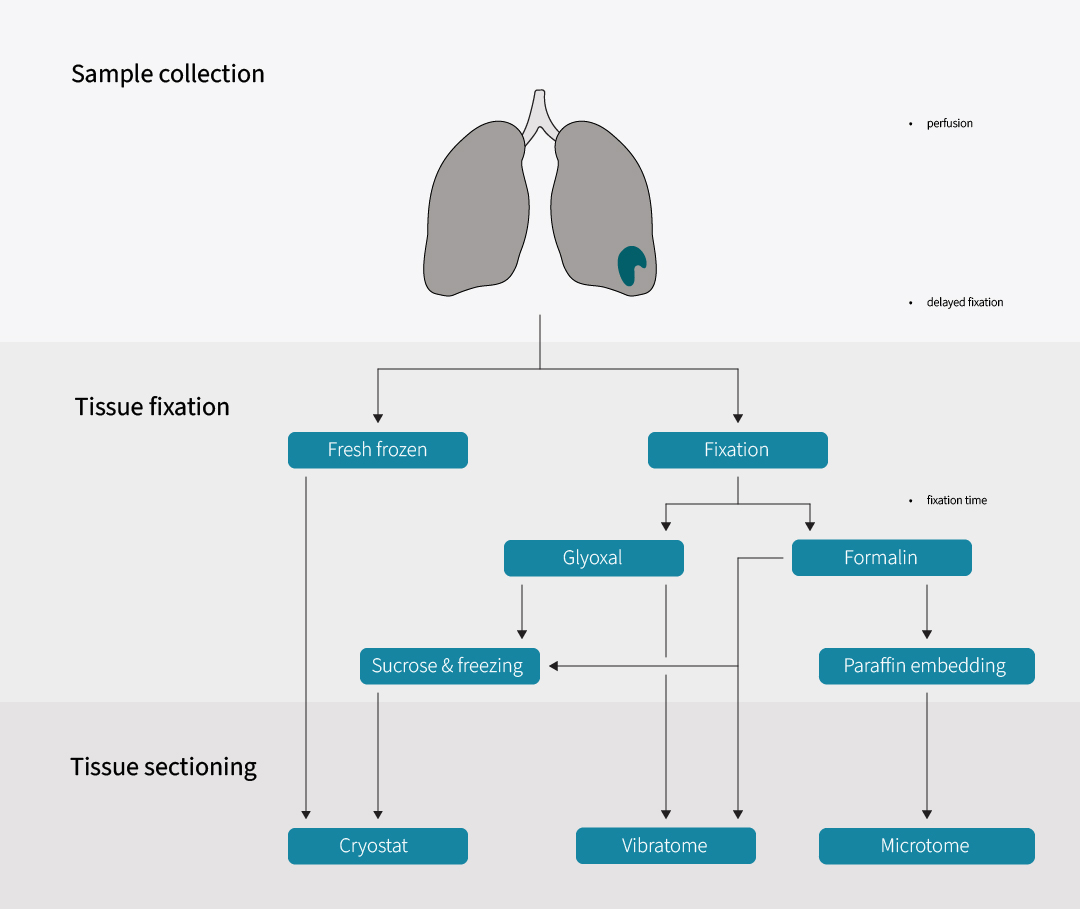
Tissue fixation is a fundamental step in histology and pathology. It preserves cellular architecture and prevents autolysis and degradation. Although fixation may seem simple, it is full of potential pitfalls that can affect diagnostic accuracy, staining quality, and downstream molecular analysis (Figure 1).
The tissue preparation process depends heavily on the experimental goal. Tissue is often rapidly frozen without chemical fixation when the integrity of DNA, RNA, and proteins must be preserved for subsequent assays, such as PCR, Western blot, and sequencing, or when maximum antigen preservation is required, especially for sensitive epitopes. However, frozen tissue sections generally require post-fixation before immunostaining (see www.sysy.com/postfixation).
For visualizing cell structures in immunohistochemical (IHC) analyses, fixation with formaldehyde- or alcohol-based fixatives is preferred due to better preservation of tissue morphology. While 10% neutral buffered formalin (NBF) is the most used fixative, it is not ideal for all purposes. Other fixatives, such as paraformaldehyde, glutaraldehyde, or alcohol-based solutions, may be preferred for immunohistochemistry or electron microscopy (e.g., Srinivasan et al., 2002, Nietner et al., 2012, Jalali et al., 2023). Glyoxal is a newer alternative to formalin for tissue fixation in IHC. Unlike formaldehyde, which mainly cross-links lysine residues, glyoxal preferentially reacts with arginine, forming shorter and less extensive cross-links. This leads to better antigen preservation and often reduces or eliminates the need for harsh antigen retrieval. It penetrates tissues faster, maintains good morphology, and is less toxic and volatile than formalin. However, glyoxal fixation is not yet fully standardized, and some staining protocols may require optimization.
Tissue preparation also depends on the selected sectioning method or on tissue storage requirements. Fixed tissues can be frozen if, after fixation, they are placed in sucrose-rich solutions with gradually increasing concentrations. Sucrose replaces water in the tissue and reduces the chance of large ice crystals forming during freezing. Paraffin embedding of fixed tissues is especially useful for long-term storage because formalin fixed and paraffin embedded (FFPE) tissue blocks are stable for years to decades at room temperature. This makes them ideal for biobanks and retrospective studies.
One of the most common mistakes is delayed fixation or freezing after tissue removal, a condition known as ‘cold ischemia’. Autolytic enzymes begin to degrade the tissue almost immediately after excision, especially in metabolically active tissues, such as the brain, liver, and intestine. Even short delays of as little as 30 minutes can result in loss of cellular detail, nuclear fading, and cytoplasmic vacuolation. Cold ischemia is also associated with RNA integrity and the expression of genes associated with hypoxia or apoptosis. Cold ischemia has been shown to affect the staining of numerous proteins (Bonnas et al., 2012, Yildiz-Aktas et al., 2012).
The time that a tissue remains in fixative must be carefully controlled to avoid under- or over-fixation. Under-fixation leads to incomplete preservation and poor morphological detail. Over-fixation, especially in formalin for extended periods (>48 hours), causes excessive crosslinking of proteins. This can mask antigenic sites, interfere with staining, and impede molecular diagnostics such as PCR or FISH due to cross-linked nucleic acids. Therefore, samples should not be stored in fixatives (see also Influence-of-formalin-fixation).
However, inadequate fixation can also be caused by insufficient fixation volume or unsuitable tissue size and thickness. Fixatives must penetrate the tissue completely. As a rule of thumb, the fixation volume ratio should be at least 10:1 (fixative to tissue). Overstuffing cassettes or using too little fixative compromises penetration. Tissue samples that are thicker than 4-5 mm do not only prevent adequate fixative penetration but since formalin diffuses slowly (~1 mm/hour), inner tissue layers may degrade before being preserved. Sectioning such tissues can lead to crumbling or tearing, resulting in uneven or non-specific staining. Fixation is also temperature dependent. Cold temperatures slow the penetration of the fixative.
Sectioning involves cutting thin slices of tissue so that cellular structures, proteins, and other molecules can be studied under a microscope. The choice of sectioning technique depends on the fixation method, tissue type, and downstream application (Figure 1). The three most common methods are vibratome, microtome and cryostat sectioning.
A vibratome uses a vibrating blade to cut fresh or lightly fixed tissues without embedding them in paraffin or freezing them. This method is especially useful for preparing relatively thick sections (30–400 µm) from formalin- or glyoxal-fixed tissue. Vibratome sections are produced by an oscillating razor blade. The sections are typically stored in a cryoprotectant buffer at -20°C or -80°C until staining. For short-term storage, the sections can also be kept at 4 °C in buffer with the addition of 0.05–0.1% sodium azide, which prevents the growth of microorganisms. The tissue sections are then stained free-floating in wells or tubes rather than mounted on slides. This approach allows better penetration of antibodies throughout the tissue volume. After staining and final washes, sections are mounted onto slides for imaging.
A microtome is used to cut thin sections from paraffin embedded tissues (FFPE). There are two main types of microtomes: sliding and rotary. A sliding microtome moves the specimen horizontally against a fixed blade, making it suitable for cutting larger or harder tissue blocks but usually producing thicker sections. A rotary microtome moves the specimen vertically into a stationary knife, allowing for very thin, uniform slices. FFPE blocks are cooled in advance to harden the paraffin wax, which is essential for producing very thin sections (2–7 µm). Before placing the sections on a slide, they must be stretched out on the surface of warm water (35–40 °C) to ensure the tissue is free of grooves or creases. After transferring the tissue sections to the slide, they are dried overnight at 37 °C. This helps the tissue to adhere to the slide and removes residual water.
The cryostat is essentially a microtome housed in a cooling chamber, used to cut frozen tissue blocks. These may be either freshly frozen unfixed samples, often embedded in OCT compound, or sucrose-pretreated frozen fixed tissues. Sections are cut at very low temperatures, typically between –20 and –30 °C. Thin sections (5–20 µm) are usually mounted directly on slides, while thicker sections (25–50 µm) can be prepared for staining using the free-floating method.
Bonnas et al., 2012. Effects of cold ischemia and inflammatory tumor microenvironment on detection of PI3K/AKT and MAPK pathway activation patterns in clinical cancer samples. PMID: 22213219
Jalali et al., 2023. Characterization of Fixatives and their Application in Histopathology. DOI: 10.26717/BJSTR.2023.47.007563
Nietner et al., 2012. Systematic comparison of tissue fixation with alternative fixatives to conventional tissue fixation with buffered formalin in a xenograft-based model. PMID: 22814649
Srinivasan et al., 2002. Effect of Fixatives and Tissue Processing on the Content and Integrity of Nucleic Acids. PMID: 12466110
Yildiz-Aktas et al., 2012. The effect of cold ischemic time on the immunohistochemical evaluation of estrogen receptor, progesterone receptor, and HER2 expression in invasive breast carcinoma. PMID: 22460807
Certificates
ISO 9001 2015 Quality Management System and Green Lab Platinum certification level for sustaining laboratory processes.


Newsletter
Sign up for our newsletter and get the latest updates and news.