-
|
-
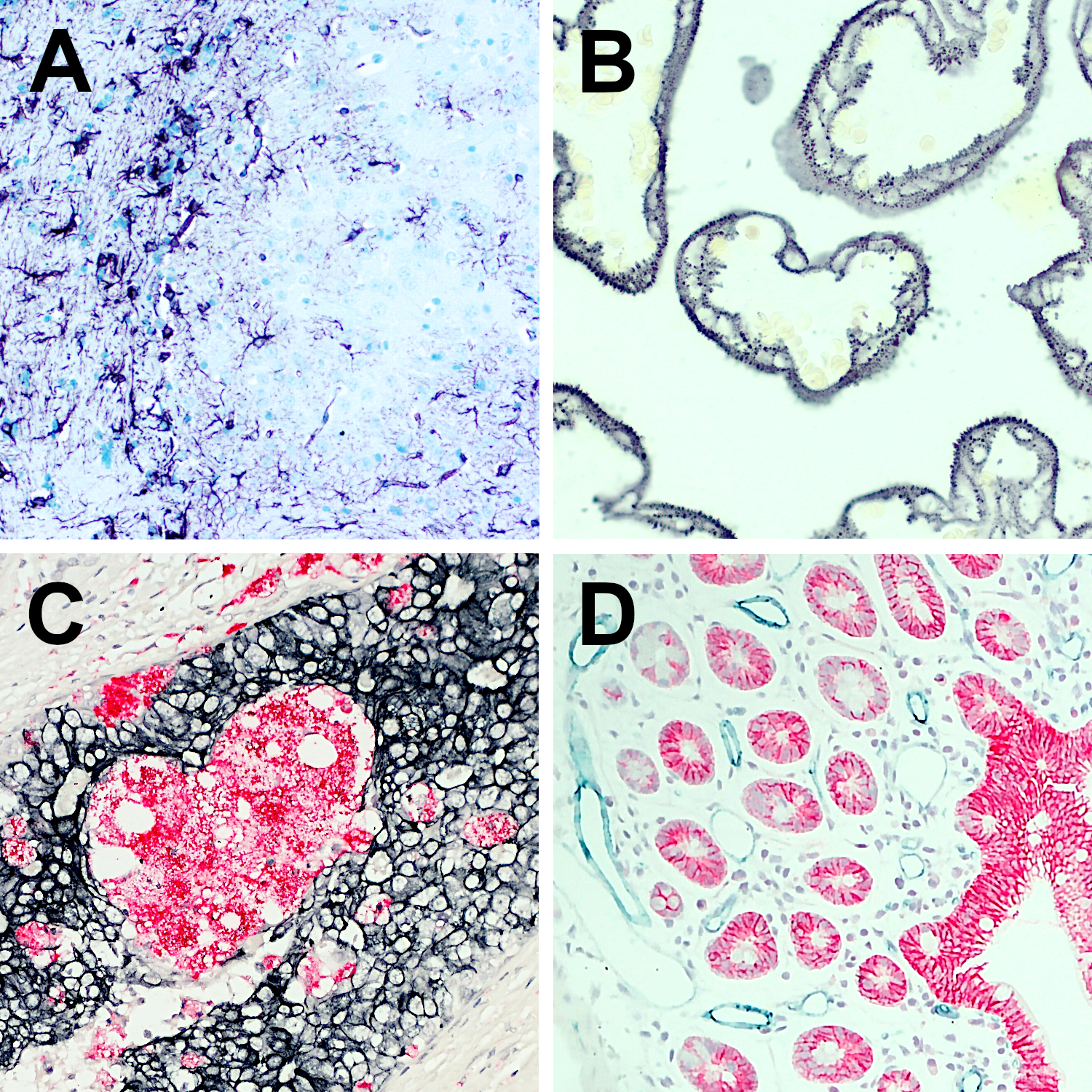
In chromogenic detection, the antibody-epitope bond is visualized using an enzyme conjugated to the secondary antibody or detection system (e.g., the ABC method). The enzyme—either horseradish peroxidase (HRP) or alkaline phosphatase (AP)—catalyzes the conversion of its chromogenic substrate into a colored precipitate at the binding site. There are many enzyme substrates for HRP- or AP-based detection that produce a wide range of colors. However, the choice of substrate should be based on the required sensitivity for visualizing the target, the nuclear counterstain used, and the compatibility of the substrates when used in combination. Figure 1 shows staining with different enzyme substrates for detection with HRP or AP.
Figure 1: Chromogenic staining with different enzyme substrates for detection with HRP or AP. A: Indirect immunostaining of a formalin fixed paraffin embedded (FFPE) mouse brain section with mouse anti-GFAP (cat. no. 173 011, dilution 1:5000, Vector VIP HRP substrate, purple). Nuclei have been visualized by Methyl Green staining (light green). B: Indirect immunostaining of a formalin fixed paraffin embedded (FFPE) human placenta section with rat anti-Cytokeratin7 (cat. no. HS-454 017, dilution 1:200, TMB HRP substrate, black). No nuclear counterstain. C: Indirect immunostaining of a formalin fixed paraffin embedded (FFPE) human breast cancer section with rabbit anti-human CD68 (cat. no. HS-460 008, dilution 1:1000, Vector Red AP substrate, red) and rat anti-Cytokeratin7 (cat. no. HS-454 017, dilution 1:100, Vector SG HRP substrate, grey). Nuclei have been visualized by hematoxylin staining (blue). D: Indirect immunostaining of a formalin fixed paraffin embedded (FFPE) mouse duodenum section with rabbit anti-E-cadherin (cat. no. HS-467 003, dilution 1:100, Vector Red AP substrate, red) and rat anti-CD31 (cat. no. HS-351 117, dilution 1:1000, HistoGreen HRP substrate, green). Nuclei have been visualized by hematoxylin staining (blue).
The reference protocols from SYSY Antibodies use horseradish peroxidase (HRP)-based chromogenic detection with 3,3'-diaminobenzidine (DAB) as substrate. HRP substrates generally produce a denser, sharper reaction product (precipitate) than AP substrates. DAB is highly stable, and stained slides remain intact for years. However, certain cells (e.g., erythrocytes, granulocytes, and neurons) contain endogenous peroxidases that can cause background staining. Endogenous peroxidases can be blocked using a 3% hydrogen peroxide incubation procedure before primary antibody incubation.
In cases where high concentrations of hydrogen peroxide may disrupt epitopes, reducing or preventing antibody-antigen binding, the 3% H₂O₂ blocking step can be performed after primary antibody incubation instead. No H₂O₂ blocking is required when using Alkaline Phosphatase (AP) or fluorescent detection.
DAB-stained slides can be dehydrated, cleared, and mounted with an organic mounting medium as outlined in the reference protocols. Organic mounting media generally provide superior optical quality compared to aqueous mounting media, which are needed when using other chromogenic substrates.
In fluorescent immunohistochemistry (IF) fluorophore-conjugated secondary antibodies localize antigen-antibody complexes. Each fluorophore absorbs light at a defined excitation wavelength and emits light at a longer emission wavelength, producing distinct colors for imaging.
Common fluorophores:
| Channel | Fluorophore | Excitation (nm) | Emission (nm) |
| Blue | DAPI | 358 | 461 |
| Green | GFP | 488 | 510 |
| CY2 | 492 | 510 | |
| Fluorescein (FITC) | 498 | 517 | |
| DY-488 | 493 | 518 | |
| Alexa Fluor 488 | 499 | 520 | |
| Orange | Cy3 | 550 | 570 |
| DsRed | 558 | 583 | |
| RFP | 555 | 584 | |
| Red | Texas Red | 595 | 613 |
| Alexa Fluor 594 | 590 | 618 | |
| Far Red | Cy5 | 660 | 570 |
| Alexa Fluor 647 | 650 | 671 | |
| DY-649 | 655 | 676 |
IF enables multiplexing, particularly for co-localized targets, and offers a high dynamic range, making it ideal for detecting both high- and low-abundance targets on the same slide. Fluorophore choice is critical for multiplex IHC, where several targets are labeled simultaneously. Careful pairing of fluorophores with non-overlapping spectra ensures clear signal distinction and reliable colocalization studies.
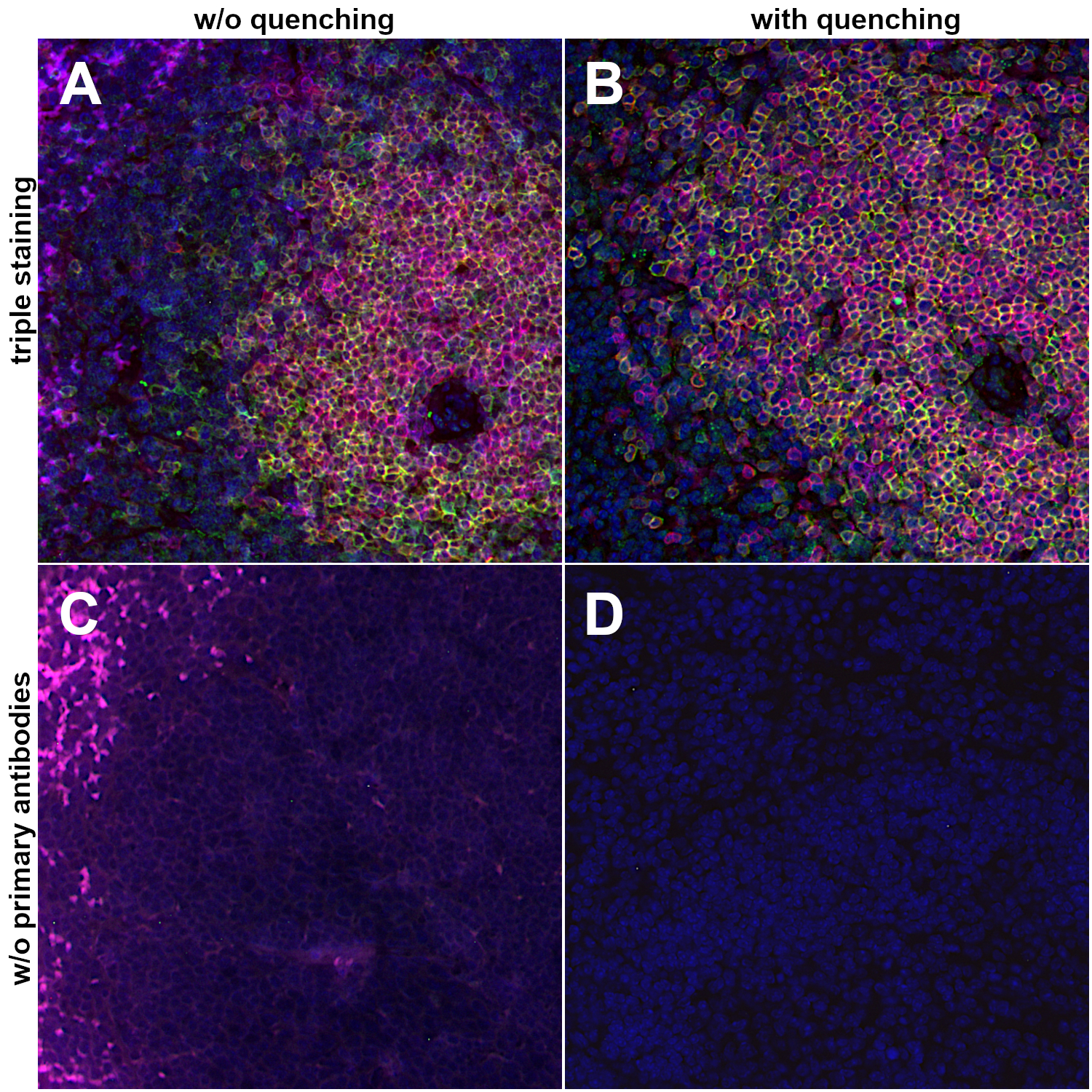
However, autofluorescence, or background fluorescence, occurs independently of specific immunofluorescent signals and can obscure target detection. Tissue components like red blood cells and collagen, as well as formalin fixation itself, are major sources. FFPE spleen and kidney tissues are especially prone to high autofluorescence, making the interpretation of assay results particularly troublesome with green-, orange- and red-channel fluorophores. Several strategies can help to reduce autofluorescence, for example the use of Sudan Black or commercial quenching kits (Figure 2).
Figure 2: Reduction of autofluorescence using Vector TrueVIEW Autofluorescence Quenching Kit. (A, B): Indirect immunostaining of formalin fixed paraffin embedded (FFPE) mouse spleen sections using rabbit anti-CD8a (cat. no. HS-361 003, dilution 1:100, anti-rabbit Cy2, purple), rat anti-CD3e (cat. no. HS-413 117, dilution 1:100, anti-rat Cy3, red) and guinea pig anti-CD4 (cat. no. HS-360 004, dilution 1:100, anti-guinea pig Cy5, green). (C, D): Indirect immunostaining of formalin fixed paraffin embedded (FFPE) mouse spleen sections without primary antibodies but using secondary antibodies anti-rabbit Cy2 (purple), anti-rat Cy3 (red) and anti-guinea pig Cy5 (green). (B, D): The tissue sections were treated with the Vector TrueVIEW Autofluorescence Quenching Kit according to the manufacturer’s protocol. The autofluorescence detected in A & C is eliminated in B & D. Nuclei have been visualized by DAPI staining (blue).
When working with animal tissues, perfusing the animals with a physiological buffer before fixation removes most blood from the vasculature, which significantly reduces red blood cell autofluorescence in IF.
To prevent signal masking, it is important to choose fluorophores that have minimal spectral overlap with the autofluorescent properties of the tissue. Far-red dyes are particularly effective, as autofluorescence rarely occurs at these wavelengths. Additionally, modern fluorophores provide enhanced brightness, stability, and narrow excitation/emission profiles, enabling cleaner and more specific signal detection. Tyramide signal amplification can be used to increase specific signal intensity over background when high endogenous autofluorescence is observed.
Certificates
ISO 9001 2015 Quality Management System and Green Lab Platinum certification level for sustaining laboratory processes.


Newsletter
Sign up for our newsletter and get the latest updates and news.