Tailor-made Antibodies
and Tools for Life Science
Home | | | | | Technical Support

USP9x antibody - 285 002

USP9x is a deubiquitinase belonging to the UBP family
Rabbit polyclonal antiserum
Cat. No.: 285 002
Amount: 200 µl
Price: $360.00

Cat. No. 285 002 200 µl antiserum, lyophilized. For reconstitution add 200 µl H2O, then aliquot and store at -20°C until use.
Antibodies should be stored at +4°C when still lyophilized. Do not freeze!
Applications
 
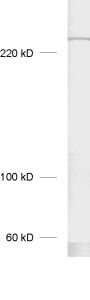
WB: 1 : 1000 (AP staining) gallery  
IP: not tested yet
ICC: not tested yet
IHC: not tested yet
IHC-P (FFPE): not tested yet

Western blot (WB); separation of proteins by PAGE and subsequent transfer to a membrane. Detection of target molecules is carried out with antibodies. Some antibodies require special sample preparation steps. For details, please refer to the “Remarks” section.

Immunoprecipitation (IP); Immunoisolation or pulldown of a target molecule using an antibody. For details and product specific hints, please refer to the ”Remarks” section.

Immunocytochemistry (ICC) on 4% PFA fixed cells. Immunoreactivity is usually revealed by fluorescence. Some antibodies require special fixation methods. For details, please refer to the “Remarks” section.

Immunohistochemistry (IHC) on 4% PFA perfusion fixed tissue with 24h PFA post fixation. Immunoreactivity is usually revealed by fluorescence or a chromogenic substrate. Some antibodies require special fixation methods or antigen retrieval steps. For details, please refer to the ”Remarks” section.

Immunohistochemistry (IHC-P) of formalin fixed, paraffin embedded (FFPE) tissue (some antibodies require special antigen retrieval steps, please refer to the ”Remarks” section). Immunoreactivity is usually revealed by fluorescence or a chromogenic substrate.

Immunogen Recombinant protein corresponding to AA 1 to 91 from mouse USP9x (UniProt Id: P70398)
Reactivity Reacts with: rat, mouse (P70398).
Other species not tested yet.
Data sheet Datasheet 285_002
Cat. No.: 285 002
Amount: 200 µl
Price: $360.00
Background

Ubiquitinylation of proteins regulates their stability and turnover and is involved in many cellular processes like endocytosis, cell-cycle regulation, transcriptional activation, etc.
Ubiquitin can be removed by deubiquitylating enzymes (DUBs) comprising ubiquitin specific proteases (USPs), or ubiquitin C-terminal hydrolases (UCHs).
Fat facets in mouse (FAM, also known as Usp9X) is a developmentally regulated UBP modulating ubiquitinylation of proteins like β-catenin, α-synuclein and others.

Certificates

ISO 9001 2015 Quality Management System and Green Lab Platinum certification level for sustaining laboratory processes.

Newsletter

Sign up for our newsletter and get the latest updates and news.
 

Please provide a valid E-Mail-Address
Please provide a valid First name
Please provide a valid Last name