Tailor-made Antibodies
and Tools for Life Science
Home | | | | | Technical Support

Abeta-pE3 antibody - 218 611

Abeta peptides are major components of neuritic plaques in Alzheimer's disease
Mouse monoclonal purified IgG
Cat. No.: 218 611
Amount: 100 µg
Price: $420.00

Cat. No. 218 611 100 µg purified IgG, lyophilized. Azide was added before lyophilization. For reconstitution add 100 µl H2O to get a 1mg/ml solution in PBS. Then aliquot and store at -20°C to -80°C until use.
Antibodies should be stored at +4°C when still lyophilized. Do not freeze!
Applications
 
WB: 1 : 1000 (AP staining) (see remarks) gallery  
IP: not tested yet
ICC: not tested yet
IHC: 1 : 100 (see remarks) gallery  
IHC-P: 1 : 500 (see remarks) gallery  

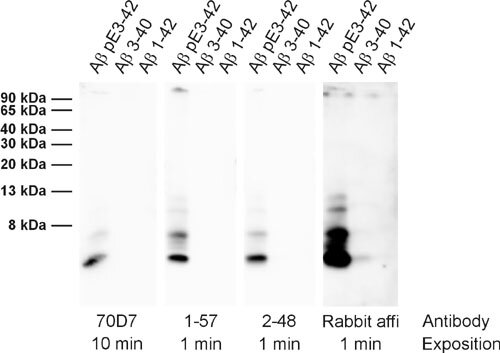
Western blot (WB); separation of proteins by PAGE and subsequent transfer to a membrane. Detection of target molecules is carried out with antibodies. Some antibodies require special sample preparation steps. For details, please refer to the “Remarks” section.

Immunoprecipitation (IP); Immunoisolation or pulldown of a target molecule using an antibody. For details and product specific hints, please refer to the ”Remarks” section.

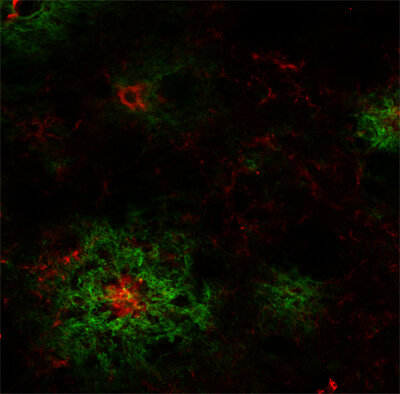
Immunocytochemistry (ICC) on 4% PFA fixed cells. Immunoreactivity is usually revealed by fluorescence. Some antibodies require special fixation methods. For details, please refer to the “Remarks” section.

Immunohistochemistry (IHC) on 4% PFA perfusion fixed tissue with 24h PFA post fixation. Immunoreactivity is usually revealed by fluorescence or a chromogenic substrate. Some antibodies require special fixation methods or antigen retrieval steps. For details, please refer to the ”Remarks” section.

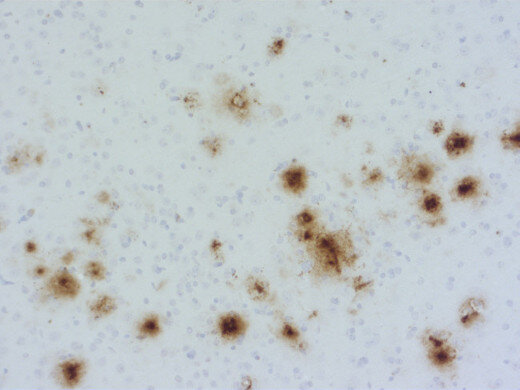
Immunohistochemistry (IHC-P) of formalin fixed, paraffin embedded (FFPE) tissue (some antibodies require special antigen retrieval steps, please refer to the ”Remarks” section). Immunoreactivity is usually revealed by fluorescence or a chromogenic substrate.

Clone 70D7
Subtype IgG3 (κ light chain)
Immunogen Synthetic peptide corresponding to the amino terminal part of human Abeta-pE3 (UniProt Id: P05067)
Reactivity Reacts with: human (P05067), rat (P08592), mouse (P12023).
Other species not tested yet.
Specificity Recognizes specific oligomeric structures formed preferentially by Abeta-pE3.
Remarks

WB: Due to the small size of this protein/peptide, we recommend a 16% Schaegger gel system.
Detects purified Abeta pE3. Complex samples like brain extracts still have to be tested. Boil membrane in PBS after blotting for 3min.
IHC: Antigen retrieval with formic acid is required.
IHC-P: Antigen retrieval with citrate buffer pH 6, followed by formic acid treatment, is required for chromogenic detection.
For chromogenic detection, an optimized AGR time of 20 minutes is recommended for best results.

Data sheet Datasheet 218_611
Cat. No.: 218 611
Amount: 100 µg
Price: $420.00
Background

Amyloid deposits, also called plaques, of Alzheimer's patients consist of several protein components like the amyloid beta-peptides (Abeta, ) 1-40/42 and additional C- and N-terminally truncated and modified fragments. Very abundant are the isoaspartate (isoAsp)-Abeta and pyroglutamyl (pGlu)-Abeta peptides. The latter are formed by cyclization of the N-terminal glutamate at position 3 or 11 catalyzed by glutaminyl cyclase (QC) resulting in very amyloidogenic and neurotoxic variants of Abeta; Abeta-pE3 and Abeta pE11.
In contrast to extracellular plaques that do not perfectly correlate with Alzheimer´s disease intraneuronal Abeta accumulation and vascular Abeta deposits have gained more and more evidence to be among the crucial factors responsible for progressive neuron loss.

Certificates

ISO 9001 2015 Quality Management System and Green Lab Platinum certification level for sustaining laboratory processes.

Newsletter

Sign up for our newsletter and get the latest updates and news.
 

Please provide a valid E-Mail-Address
Please provide a valid First name
Please provide a valid Last name