Tailor-made Antibodies
and Tools for Life Science
Home | | | | | Technical Support

VAMP1/2/3 antibody - 104 203 K.D.

Vamp1, 2 and 3 are major vesicle protein involved in fusion
Rabbit polyclonal purified antibody
Cat. No.: 104 203
Amount: 50 µg
Price: $460.00

Cat. No. 104 203 50 µg specific antibody, lyophilized. Affinity purified with the immunogen. Albumin and azide were added for stabilization. For reconstitution add 50 µl H2O to get a 1mg/ml solution in PBS. Then aliquot and store at -20°C to -80°C until use.
Antibodies should be stored at +4°C when still lyophilized. Do not freeze!
Applications
 
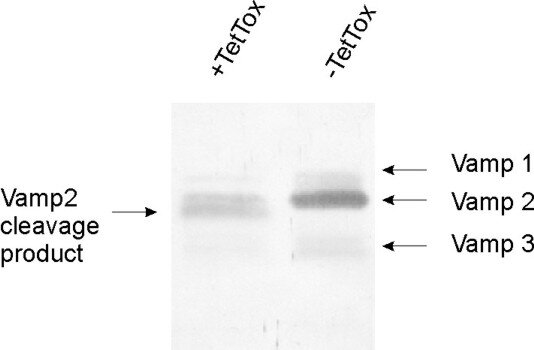
WB: 1 : 1000 up to 1 : 5000 (AP staining) (see remarks) gallery  
IP: not recommended
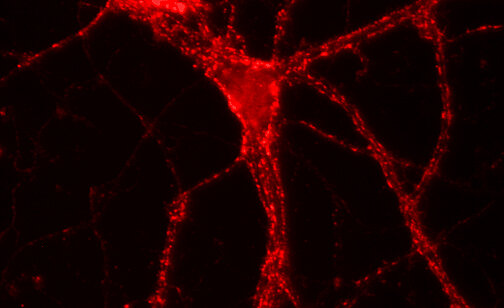
ICC: 1 : 500 gallery  
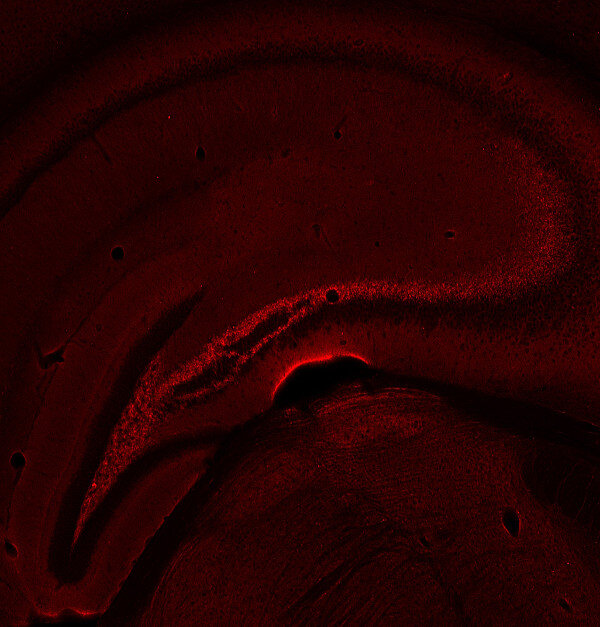
IHC: 1 : 200 gallery  
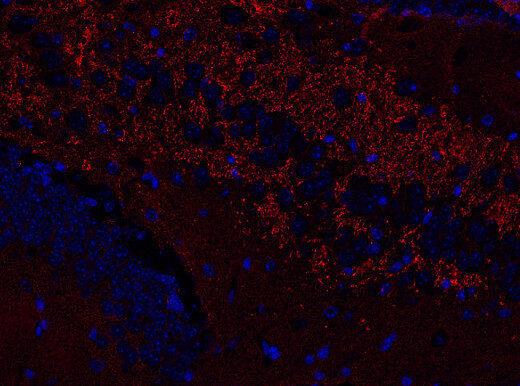
IHC-P: 1 : 500 gallery  
DNA-PAINT: external data (see remarks)
ELISA: yes (see remarks)

Western blot (WB); separation of proteins by PAGE and subsequent transfer to a membrane. Detection of target molecules is carried out with antibodies. Some antibodies require special sample preparation steps. For details, please refer to the “Remarks” section.

Immunoprecipitation (IP); Immunoisolation or pulldown of a target molecule using an antibody. For details and product specific hints, please refer to the ”Remarks” section.

Immunocytochemistry (ICC) on 4% PFA fixed cells. Immunoreactivity is usually revealed by fluorescence. Some antibodies require special fixation methods. For details, please refer to the “Remarks” section.

Immunohistochemistry (IHC) on 4% PFA perfusion fixed tissue with 24h PFA post fixation. Immunoreactivity is usually revealed by fluorescence or a chromogenic substrate. Some antibodies require special fixation methods or antigen retrieval steps. For details, please refer to the ”Remarks” section.

Immunohistochemistry (IHC-P) of formalin fixed, paraffin embedded (FFPE) tissue (some antibodies require special antigen retrieval steps, please refer to the ”Remarks” section). Immunoreactivity is usually revealed by fluorescence or a chromogenic substrate.

In antibody-based DNA-PAINT (Point Accumulation in Nanoscale Topography), a short oligomeric docking strand is coupled to a specific antibody. The transient association of the fluorophore to the antibody is mediated by the pairing of a short fluorescently labeled complementary imager DNA strand. DNA-PAINT allows super-resolution imaging and the imaging of a huge number of antibodies on the same biological sample in a single multiplex experiment. For additional experimental details refer to the Remarks section.

Enzyme-linked immunosorbent assay (ELISA); a frequently employed method to quantify target-molecules in solution. The detection of some proteins requires special solubilization steps. For further information, please refer to the „Remarks“ section.

Immunogen Recombinant protein corresponding to AA 1 to 82 from rat Cellubrevin (UniProt Id: P63025)
Reactivity Reacts with: human (P23763, P63027, Q15836), rat (Q63666, P63045, P63025), mouse (Q62442, P63044, P63024), zebrafish.
Other species not tested yet.
Specificity Specific for all three isoforms VAMP 1, 2 and 3. K.D. validated PubMed: 31128202
Remarks

WB: This antibody detects the tetanus and Botulinum B toxin cleavage product in toxin treated tissue homogenates.
DNA-PAINT: This antibody has been successfully applied and published for this method by customers (see application-specific references).
ELISA: The ELISA-protocol for membrane proteins is required.
Suitable as detector antibody for sandwich-ELISA. Please refer to the protocol for suitable capture antibodies.

Data sheet Datasheet 104_203

References for VAMP1/2/3 - 104 203

The endothelial diapedesis synapse regulates transcellular migration of human T lymphocytes in a CX3CL1- and SNAP23-dependent manner.
Schoppmeyer R, van Steen ACI, Kempers L, Timmerman AL, Nolte MA, Hombrink P, van Buul JD
Cell reports (2022) 383: 110243. 104 203 WB; tested species: human
Role of SNAREs in the Atopic Dermatitis-related Cytokine Secretion and Skin-Nerve Communication.
Meng J, Wang J, Buddenkotte J, Buhl T, Steinhoff M
The Journal of investigative dermatology (2019) : . 104 203 WB, ICC; KD verified; tested species: human
Adaptor Protein-3-Mediated Trafficking of TLR2 Ligands Controls Specificity of Inflammatory Responses but Not Adaptor Complex Assembly.
Petnicki-Ocwieja T, Kern A, Killpack TL, Bunnell SC, Hu LT
Journal of immunology (Baltimore, Md. : 1950) (2015) 1959: 4331-40. 104 203 WB, ICC
Generation of self-organized autonomic ganglion organoids from fibroblasts.
Liu S, Xiang K, Yuan F, Xiang M
iScience (2023) 263: 106241. 104 203 ICC; tested species: mouse
TLR7 trafficking and signaling in B cells is regulated by the MHCII-associated invariant chain.
Tohme M, Maisonneuve L, Achour K, Dussiot M, Maschalidi S, Manoury B
Journal of cell science (2020) 1335: . 104 203 ICC; tested species: mouse
Role of SNAREs in the Atopic Dermatitis-related Cytokine Secretion and Skin-Nerve Communication.
Meng J, Wang J, Buddenkotte J, Buhl T, Steinhoff M
The Journal of investigative dermatology (2019) : . 104 203 WB, ICC; KD verified; tested species: human
The Kohlschütter-Tönz syndrome associated gene Rogdi encodes a novel presynaptic protein.
Riemann D, Wallrafen R, Dresbach T
Scientific reports (2017) 71: 15791. 104 203 ICC; tested species: rat
Adaptor Protein-3-Mediated Trafficking of TLR2 Ligands Controls Specificity of Inflammatory Responses but Not Adaptor Complex Assembly.
Petnicki-Ocwieja T, Kern A, Killpack TL, Bunnell SC, Hu LT
Journal of immunology (Baltimore, Md. : 1950) (2015) 1959: 4331-40. 104 203 WB, ICC
Botulinum protease-cleaved SNARE fragments induce cytotoxicity in neuroblastoma cells.
Arsenault J, Cuijpers SA, Ferrari E, Niranjan D, Rust A, Leese C, O'Brien JA, Binz T, Davletov B
Journal of neurochemistry (2014) 1295: 781-91. 104 203 ICC; tested species: mouse
Spatial proteomics in neurons at single-protein resolution.
Unterauer EM, Shetab Boushehri S, Jevdokimenko K, Masullo LA, Ganji M, Sograte-Idrissi S, Kowalewski R, Strauss S, Reinhardt SCM, Perovic A, Marr C, et al.
Cell (2024) 1877: 1785-1800.e16. 104 203 DNA-PAINT; tested species: rat
Cat. No.: 104 203
Amount: 50 µg
Price: $460.00
The endothelial diapedesis synapse regulates transcellular migration of human T lymphocytes in a CX3CL1- and SNAP23-dependent manner.
Schoppmeyer R, van Steen ACI, Kempers L, Timmerman AL, Nolte MA, Hombrink P, van Buul JD
Cell reports (2022) 383: 110243. 104 203 WB; tested species: human
Role of SNAREs in the Atopic Dermatitis-related Cytokine Secretion and Skin-Nerve Communication.
Meng J, Wang J, Buddenkotte J, Buhl T, Steinhoff M
The Journal of investigative dermatology (2019) : . 104 203 WB, ICC; KD verified; tested species: human
Adaptor Protein-3-Mediated Trafficking of TLR2 Ligands Controls Specificity of Inflammatory Responses but Not Adaptor Complex Assembly.
Petnicki-Ocwieja T, Kern A, Killpack TL, Bunnell SC, Hu LT
Journal of immunology (Baltimore, Md. : 1950) (2015) 1959: 4331-40. 104 203 WB, ICC
Generation of self-organized autonomic ganglion organoids from fibroblasts.
Liu S, Xiang K, Yuan F, Xiang M
iScience (2023) 263: 106241. 104 203 ICC; tested species: mouse
TLR7 trafficking and signaling in B cells is regulated by the MHCII-associated invariant chain.
Tohme M, Maisonneuve L, Achour K, Dussiot M, Maschalidi S, Manoury B
Journal of cell science (2020) 1335: . 104 203 ICC; tested species: mouse
Role of SNAREs in the Atopic Dermatitis-related Cytokine Secretion and Skin-Nerve Communication.
Meng J, Wang J, Buddenkotte J, Buhl T, Steinhoff M
The Journal of investigative dermatology (2019) : . 104 203 WB, ICC; KD verified; tested species: human
The Kohlschütter-Tönz syndrome associated gene Rogdi encodes a novel presynaptic protein.
Riemann D, Wallrafen R, Dresbach T
Scientific reports (2017) 71: 15791. 104 203 ICC; tested species: rat
Adaptor Protein-3-Mediated Trafficking of TLR2 Ligands Controls Specificity of Inflammatory Responses but Not Adaptor Complex Assembly.
Petnicki-Ocwieja T, Kern A, Killpack TL, Bunnell SC, Hu LT
Journal of immunology (Baltimore, Md. : 1950) (2015) 1959: 4331-40. 104 203 WB, ICC
Botulinum protease-cleaved SNARE fragments induce cytotoxicity in neuroblastoma cells.
Arsenault J, Cuijpers SA, Ferrari E, Niranjan D, Rust A, Leese C, O'Brien JA, Binz T, Davletov B
Journal of neurochemistry (2014) 1295: 781-91. 104 203 ICC; tested species: mouse
Spatial proteomics in neurons at single-protein resolution.
Unterauer EM, Shetab Boushehri S, Jevdokimenko K, Masullo LA, Ganji M, Sograte-Idrissi S, Kowalewski R, Strauss S, Reinhardt SCM, Perovic A, Marr C, et al.
Cell (2024) 1877: 1785-1800.e16. 104 203 DNA-PAINT; tested species: rat
Background

Synaptobrevins/VAMPs represents a family of integral membrane proteins of 11-13 kDa with the N-terminal region exposed to the cytoplasm and a C-terminal transmembrane domain. Two isoforms were identified in the mammalian CNS, synaptobrevin 1 (VAMP 1 or p18-1) and synaptobrevin 2 (VAMP 2 or p18-2) that differ in their distribution within different brain regions.
Synaptobrevin 1 is highly conserved between vertebrates and invertebrates. It is a major constituent of synaptic vesicles and peptidergic secretory granules in all neurons examined so far. In addition, it is present on secretory granules of neuroendocrine cells. Low levels of synaptobrevin 2 are present in many other tissues where the protein resides on specialized microvesicles.
In non-neuronal cells the third isoform, cellubrevin (VAMP 3), is present where it is localized to an endosomal membrane pool.
Synaptobrevin/VAMP is an essential component of the exocytotic fusion machine, related to a larger protein family referred to as v-SNAREs. It is the sole target for tetanus and several of the botulinal neurotoxins which cleave the protein at single sites in the C-terminal portion of the molecule.

Certificates

ISO 9001 2015 Quality Management System and Green Lab Platinum certification level for sustaining laboratory processes.

Newsletter

Sign up for our newsletter and get the latest updates and news.
 

Please provide a valid E-Mail-Address
Please provide a valid First name
Please provide a valid Last name